Shell Eco-marathon Autonomous Programming Competition 2025
Virtual Competition
April 16 – May 28, 2025
After a hiatus last year, the Autonomous Programming Competition is back with significant improvements, offering a lower barrier of entry to encourage wider participation.
This completely virtual global competition, supported by Southwest Research Institute, challenges participants to enhance the performance of control software for a baseline simulated autonomous vehicle, providing an excellent opportunity for any team to get introduced to autonomous programming.
The results are in! Scroll down to see the winners and how other competitors performed
Autonomous Programming Competition Winners
1st Place
ITS TEAM SAPUANGIN
Institut Teknologi Sepuluh Nopember, Indonesia
2nd Place
Shoubra Racing Team
Benha University, Egypt
3rd Place
Cairo university eco racing team
Cairo University, Egypt
Full Results
| Rank | Team Name | School Name | Country | Attempts | Goals | Efficiency (km/kWh) |
Time (s) | Distance (km) |
Energy (kWh) |
1 |
ITS TEAM SAPUANGIN | Institut Teknologi Sepuluh Nopember | Indonesia | 6 | 14/14 | 17.92 | 451.5 | 2.76 | 0.154 |
| 2 | Shoubra Racing Team | Benha University | Egypt | 6 | 14/14 | 15.98 | 384.3 | 2.92 | 0.183 |
| 3 | Cairo university eco racing team | Cairo University | Egypt | 6 | 14/14 | 14.77 | 347.3 | 2.88 | 0.195 |
| 4 | Semar Urban UGM | Universitas Gadjah Mada | Indonesia | 3 | 12/14 | ||||
| 5 | SZEnergy Team | Szechenyi Istvan University | Hungary | 3 | 12/14 | ||||
| 6 | Semar Proto UGM | Universitas Gadjah Mada | Indonesia | 6 | 12/14 | ||||
| 7 | Antasena ITS Team | Institut Teknologi Sepuluh Nopember | Indonesia | 5 | 9/14 | ||||
| 8 | Team Envision PNEC NUST - Prototype | National University of Sciences and Technology Karachi | Pakistan | 6 | 9/14 | ||||
| 9 | Menofia Racing Team | Menofia University | Egypt | 3 | 5/14 | ||||
| 10 | RobEn | Arab Academy for Science, Technology & Maritime Transport | Egypt | 6 | 3/14 | ||||
| 11 | UBD-AutoNav | Universiti Brunei Darussalam | Brunei Darussalam | 1 | 0/14 | ||||
| 12 | Milhas Gerais | Universidade Federal de São João del-Rei Santo Antonio | Brazil | 1 | 0/14 | ||||
| 13 | CarBonnAra | Rheinische Friedrich Wilhelms Universitaet Bonn | Germany | 1 | 0/14 | ||||
| 14 | Assuit Eco-Racing Team | Assuit University | Egypt | 1 | 0/14 | ||||
| 15 | UCL HyperMile | University College London | United Kingdom | 1 | 0/14 | ||||
| 16 | BME RoboShark | Budapest University of Technology and Economics | Hungary | 1 | 0/14 | ||||
| 17 | RAKATA TEAM | Institut Teknologi Bandung | Indonesia | 1 | 0/14 | ||||
| 18 | PRAVEGA | Government Engineering College Barton Hill | India | 1 | 0/14 | ||||
| 19 | Team ETA | Somaiya Vidyavihar University | India | 1 | 0/14 | ||||
| 20 | H2politO Molecole Urbane | Politecnico Di Torino | Italy | 1 | 0/14 | ||||
| 21 | Team ABU Zaria | Ahmadu Bello University | Nigeria | 1 | 0/14 | ||||
| 22 | Cairo university eco-racing team-HORUS | Cairo University | Egypt | 3 | 0/14 | ||||
| 23 | Team Envision PNEC NUST - Urban | National University of Sciences and Technology Karachi | Pakistan | 5 | 0/14 | ||||
| 24 | Team AVERERA | Indian Institute of Technoloy - Banaras Hindu University | India | 6 | 0/14 |
Competition Schedule
From February, Teams will have the opportunity to program and test their control algorithms in a test environment. This test environment will not have competition characteristics such as goal points or traffic. This will allow Teams to get familiar with the basic operation of the vehicle.
From April 16th until April 29th, Teams will be able to test their programming in a Practice period within the CARLA simulator, where traffic and goal points are available. Any attempts made during this Practice time will not count to their final result.
The official competition will take place from April 30th until May 28th, 2025.
Any of these dates may be subject to change according to the Organiser's discretion and will be announced on the Shell Eco-marathon website and social channels.
How the competition works
At the start of practice and competition, details will be announced on this website including the coordinates of the starting point, the number of goal points required to pass, and the maximum run time. The vehicle can pass these goal points in no particular order and must pass them within 3 meters of the published location, leaving it up to the Team to determine the most efficient approach.
Registration
Registration
Teams must register through the Shell Eco-marathon Registration Portal, starting September 2, 2024. From the start of the testing period in February, registered Teams will receive an invitation to set up their Team account on this website.
Teams are allowed to register for this competition until the start of the competition. Invitations will be sent out once every week.
Teams are encouraged to register early to ensure adequate preparation time and access to all available resources.
Preparation
Preparation
When logged in, the Team will be able to download an example project in the form of Robot Operating System (ROS) packages. These packages will contain source code for ROS nodes, build instructions and general package information, which is meant to demonstrate the process for testing, submitting and getting results for Shell Eco-marathon simulation projects.
The Team can modify and improve the example ROS stack to perform in the real-world simulation environment within CARLA, provided by SwRI. This modification involves the development of path planning, perception, and control algorithms.
How to Participate
How to Participate
When the Team's code is ready to be submitted for simulation, they can upload their code on this website. The uploaded submissions will be queued and processed in order of uploading.
The following conditions apply during competition:
- Every Team will have a maximum of six attempts (uploaded) in total, with a maximum of one (1) attempt per day, measured by time of upload (days end at 23:59 Greenwich Mean Time (GMT)).
- Teams have the responsibility to ensure that their code will compile before they upload it. If a submission does not compile, it will still count to the total number of attempts, so thorough testing is crucial.
- The attempt will end when all goal points are passed, when the maximum simulation time has passed, or when the code fails to compile.
- The attempt will be considered invalid if the vehicle performs behaviour that would be deemed dangerous or careless in a real-world vehicle. This includes, but is not limited to, driving the vehicle in reverse for an extended period of time, driving against the flow of lane traffic, colliding with obstacles, driving over sidewalks and other non-drivable areas, etc. The competition is using right-hand traffic.
- An attempt will be deemed as valid when it has passed the required number of goal points within the maximum allowed time. Any attempt which does not pass the required goal points within time, or which fails to compile, will be deemed as invalid.
- Both valid and invalid attempts will count towards the total number of attempts.
- After the attempt has completed, the Team will be able to evaluate their performance by downloading the resulting ROS Bag to play back the simulation on their own computer (this play back does not require CARLA, only a ROS installation).
- If the resulting score of the attempt is higher than the Team's previous attempts, the score will be reflected on the leader board.
On the final day of competition (May 28, 2025), the leader board will be taken offline while Teams can still submit their final attempt. On this last day, the time of uploading is what counts; submissions queued before the cut-off time will still be run.
The official final result will be announced once all attempts are validated by the Technical Team.
Competition Scoring
Competition Scoring
Shell Eco-marathon encourages students to solve engineering challenges by building energy-efficient vehicles. Likewise, the Autonomous Programming Competition promotes the development of energy-efficient autonomy algorithms. Each Team with a valid attempt will be ranked based on their achieved Energy Efficiency, expressed in km/kWh.
This metric is calculated by dividing the Distance travelled by the Energy Usage. To achieve a high score, Teams must maximize the distance their vehicle travels while minimizing the energy consumed. Efficient path planning, precise vehicle control, and energy-conscious driving strategies are key to achieving the best results.
Energy Usage refers to the total amount of energy consumed by the vehicle to complete the challenge. Factors such as vehicle speed, acceleration, and manoeuvring are considered. Lower energy usage contributes positively to the overall efficiency score.
Distance is the total distance the vehicle travels during the challenge. Teams that optimize their route and maintain precise control over the vehicle to cover the necessary distance efficiently will enhance their overall score.
An example leader board matrix can be found on this site.
Violations such as speeding and crossing lane lines will be closely monitored during each attempt. A percentage penalty for every infraction will be added to the total Energy Usage at the end of the attempt, impacting the final score. Penalties will be calculated and communicated to Teams after review of the attempt.
Teams should focus on optimizing both their energy consumption and travel distance while strictly adhering to driving regulations within the simulated environment to achieve the highest possible Energy Efficiency score.
When a Team submits multiple valid attempts, only their highest Energy Efficient attempt will be considered for classification, meaning if a Team submits a later valid attempt which scores lower, this will not affect their overall standing.
Ties will be broken by order of code submission date, meaning the Team that submitted their code first will win the tie.
Technical Specifications
Technical Specifications
The Team's code is built is executed in a simulation environment operating on the following:
- Ubuntu 22.04 (Jammy Jellyfish)
- CARLA 0.9.15
- CARLA ROS Bridge
- Team code can be developed for:
Please see the Resources page for more information on how to use these and other related concepts.
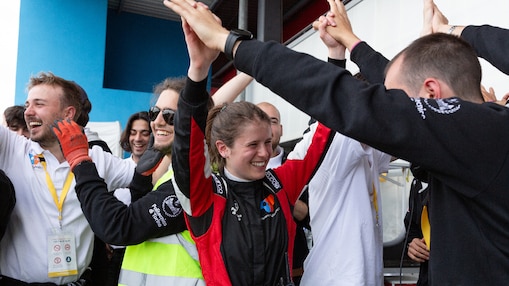
Shell Eco-marathon 2025 Programme
The 2025 season promises to be an exciting one: welcoming participants, guests, partners, and supporters to new locations, and bringing fresh perspectives and experiences as teams take on new challenges, while pushing the boundaries of innovation.
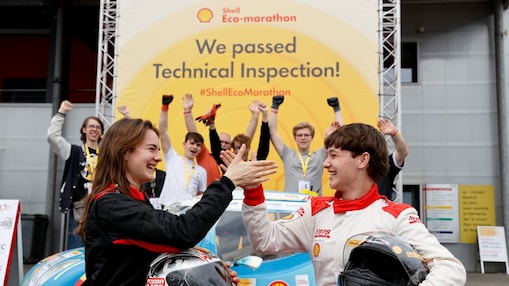
A cleaner energy future requires brilliant Changemakers
Shell Eco-marathon aims to empower the next generation of energy leaders. The competition embodies the spirit of these Changemakers – their perseverance, collaboration, and innovation – and ties it to Shell’s purpose of helping achieve a cleaner energy future for all.